


Google unveils Gemini 4 Carbon with cybersecurity benchmark gains
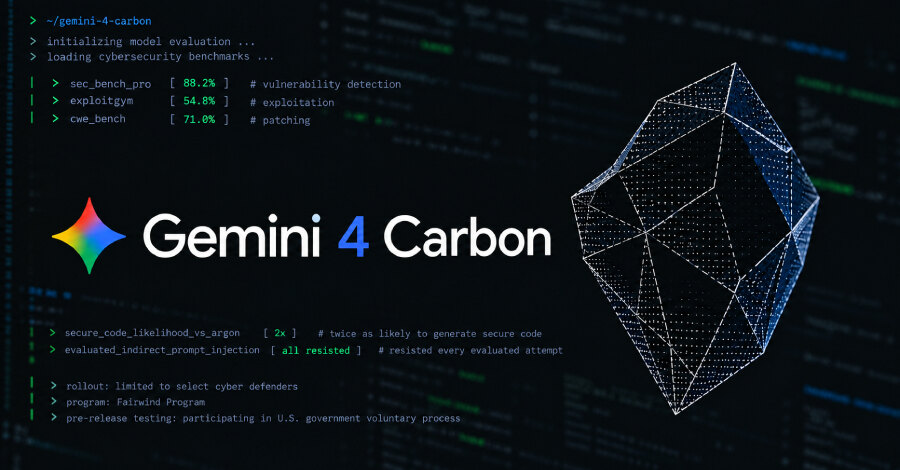
Google has unveiled Gemini 4 Carbon, a frontier model designed for long-horizon, coding and cybersecurity tasks. The company reported scores of 88.2% on SEC-bench Pro for vulnerability discovery, 54.8% on ExploitGym for exploitation, and 71.0% on CWE-bench for patching.
Koray Kavukcuoglu, senior vice president of Google DeepMind and chief AI architect at Google, said Carbon shows significant gains in coding and agentic work as well as capabilities relevant to cyber defence. On the Artificial Analysis Intelligence Index, Google said Carbon scored 59, ahead of Claude Opus 5.5 at 58, GPT-6 Astra at 57 and GPT-6.1 Sol at 55.
Security capability is a central focus
Google described cybersecurity as a core focus for Gemini 4 Carbon. It said the model improves performance in vulnerability detection, validation and remediation, and is twice as likely to generate secure code as Gemini 4 Argon, released less than a week earlier.
The company also highlighted model behaviour under uncertainty. Carbon is intended to seek human input when a complex or high-pressure task is ambiguous, rather than guessing or forcing a route forward. Google further said the model resisted every evaluated indirect prompt-injection attempt.
Controlled access and pre-release testing
Gemini 4 Carbon is initially available only to a subset of cyber defenders. Google plans to extend access to other trusted partners through its Fairwind Program, following an approach similar to the prior release. The company said it is also participating actively in the U.S. government’s voluntary pre-release model-testing process.
The announcement arrives during a period of rapid claims around advanced AI and security work. OpenAI recently introduced GPT-6.1 Terra, which it said meets the Critical threshold for cybersecurity under its Preparedness Framework and retains protections developed for GPT-6 Astra. OpenAI also said Terra showed stronger scope adherence, clearer disclosure of limitations and resistance to malicious prompt-injection instructions in its evaluations.
Evidence of increasingly capable exploit research
Anthropic this week said an unreleased internal research model identified critical vulnerabilities in widely used software. The issues included a one-click remote-code-execution vulnerability in Google Chrome, a one-click Apple Safari exploit chain affecting browsing data, an Android lock-screen bypass, and a denial-of-service flaw in the Windows HTTP.sys driver, tracked as CVE-2026-33096 with a CVSS score of 7.5.
Google, Apple and Microsoft have fixed the issues identified by Anthropic. Anthropic said the demonstrated chains showed that models could create sophisticated, multi-step exploits in open-source and proprietary software with little human involvement, then demonstrate them through working exploits.
What security leaders should take from the release
Benchmark results do not by themselves establish how a model will perform in every production environment, but the reported figures illustrate why AI-assisted vulnerability work is becoming a governance concern as well as a productivity opportunity. Businesses evaluating these tools should preserve human review for ambiguous tasks, validate generated patches in controlled environments, and apply access controls proportionate to the sensitivity of their code and security workflows.