


Northrop prepares robotic propulsion upgrade for Optus satellite
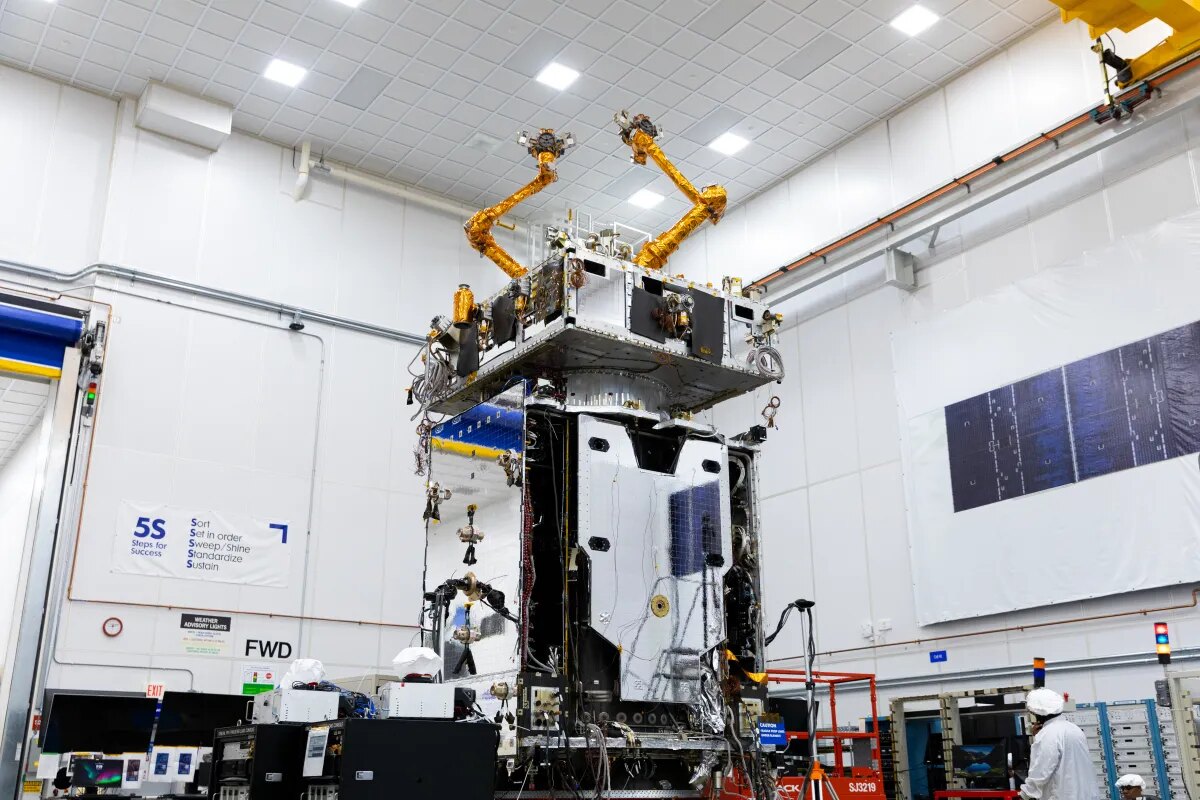
Northrop Grumman has detached a Mission Extension Vehicle (MEV) from an Optus communications satellite after more than a year of providing orbital support. The Australian operator’s satellite launched in 2009 with a planned 15-year lifetime. Northrop now plans to use its Mission Robotic Vehicle (MRV) in 2027 to install a Mission Extension Pod (MEP), a change intended to keep the spacecraft in service for a further six years if the mission proceeds as planned.
The MRV and three MEPs launched in July aboard a SpaceX Falcon 9 and are travelling towards targets roughly 27,000 miles above Earth. The transition replaces one life-extension spacecraft with a modular propulsion unit that will remain attached to the customer satellite.
From docking vehicle to reusable robotic servicer
Northrop has two MEVs in orbit, launched in 2019 and 2020. The company says they have delivered 10 years of life extension across three customer missions: two Intelsat spacecraft and the Optus satellite. MEV-1 is due to wait in a parking orbit for another customer, while MEV-2 remains attached to an Intelsat spacecraft until 2030.
MEVs use a docking probe that connects with a satellite’s thruster nozzle. Their role is to keep a client spacecraft in the required orbit after it has exhausted fuel, even when its computers and communications equipment remain usable. The MRV introduces a different arrangement: operators purchase and own the MEPs, while the MRV installs them and can then service another spacecraft.
The MRV carries two robotic arms developed by DARPA, the US military research organisation. Its task will be to autonomously approach the Optus satellite and carefully attach a pod while both vehicles are travelling at orbital speeds. Unlike most satellites, the MRV is also designed for in-orbit refuelling, which Northrop presents as a demonstration of a capability that future servicing systems may require.
A growing case for satellite life extension
Lower launch costs and less expensive spacecraft components are making repair and servicing missions more feasible, while large, costly satellites remain candidates for life extension. Northrop’s Cassie Wong described the objective as a more sustainable and resilient space infrastructure able to support repairs, upgrades, maintenance and life extension.
The programme also sits alongside changing military interest in orbital systems. In commercial space support for Space Force missions, the activity of True Anomaly and Rocket Lab illustrates how commercial space companies are becoming more relevant to Space Force missions and orbital awareness.
Northrop says its vehicles are focused on servicing, although Wong expects the MRV could eventually add components to satellites or alter their orbits, including for defence customers and potentially for valuable assets in low Earth orbit. The company’s approach contrasts with fleets of lower-cost, replaceable low-orbit satellites such as Starlink and Amazon LEO.
For operators of high-value spacecraft, the Optus mission shows that end-of-fuel need not automatically mean end-of-service. The practical implication is to assess servicing compatibility and lifecycle economics during satellite planning, while recognising that robotic docking, payload attachment and in-orbit refuelling add technical and mass trade-offs.