


OpenAI details AI pipeline that generated 948 Linux LPE exploits
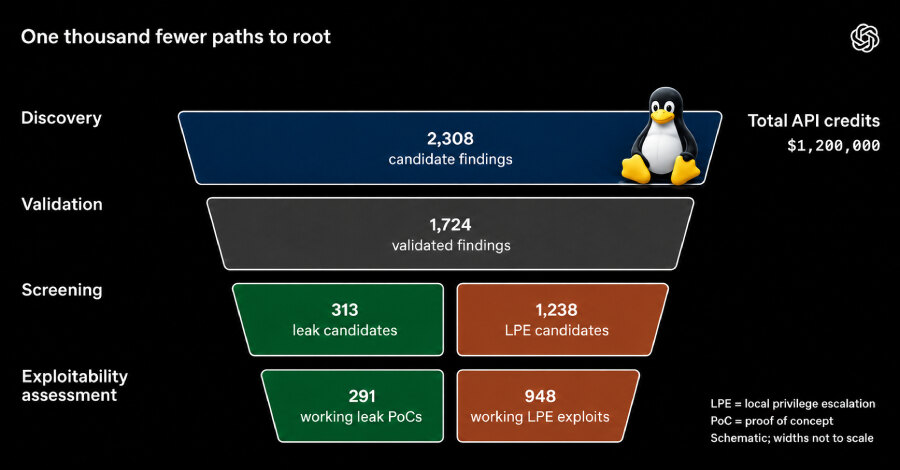
OpenAI has described an agentic security pipeline that generated 948 working local privilege-escalation exploits for a commonly used Linux distribution during a 30-hour run in mid-October 2026. The prototype used an upcoming cyber-focused model, reproduced 1,724 vulnerabilities, and also produced proof-of-concept exploits for 291 information-disclosure flaws.
The run cost $1,213,430 in API credits, or about $1,279 for each local privilege-escalation exploit. OpenAI said the system began with 2,308 candidate Linux kernel findings and that its agents discovered and used at least 10 novel Linux exploitation techniques.
Five stages from code review to human decision
The workflow is designed to connect vulnerability research, exploit development and remediation. First, agents identify high-value audit targets: security-relevant sections of code that low-privileged users can reach. They then investigate candidate findings rather than treating every suspected issue as a confirmed defect.
In dynamic validation, the agents attempt to reproduce each candidate in a sandboxed environment and retain runtime evidence. The next stage assesses exploitability, testing whether a validated flaw can enable information disclosure or local privilege escalation and developing a proof of concept where possible.
Agents then generate patches for identified vulnerabilities. Security researchers perform the final review of the exploit, the patch and the proposed severity before a report is sent to maintainers. OpenAI said this expert-guided iteration can help produce patches that are functionally correct, consistent with existing coding styles and robust against attack variants.
New exploitation methods and a faster exposure cycle
OpenAI identified two persistent elastic objects for spraying objects in a target kernel cache, two page-grooming methods intended to improve reliability, five data-only approaches for privilege escalation directly or through an arbitrary write, and one technique involving arbitrary type confusion.
The results extend OpenAI's June disclosure that its GPT-5.5-Cyber model had found 24 Linux local privilege-escalation exploits. They also add context to AI security research and model exploitation as AI systems increasingly appear in both offensive research and defensive security workflows.
VulnCheck has characterized AI-assisted vulnerability discovery as a growing risk category, noting that such tools can lower the expertise needed to find software flaws. Google Threat Intelligence Group reported that monthly disclosed vulnerabilities rose from 5,045 in January 2026 to 10,740 in August, while high-risk disclosures increased from 131 to 350 over the same period.
The U.K. National Cyber Security Centre said defensive AI-cyber tools can shorten the interval between a zero-day and an N-day vulnerability, but warned that systems remain exposed without correct and widespread configuration. OpenAI's practical implication is stark: organisations should regard low-privileged access on systems missing available patches as potentially equivalent to root access for a well-resourced threat actor, making faster patching, testing and deployment processes a business priority.