


Red Hat patches critical Quay registry flaws
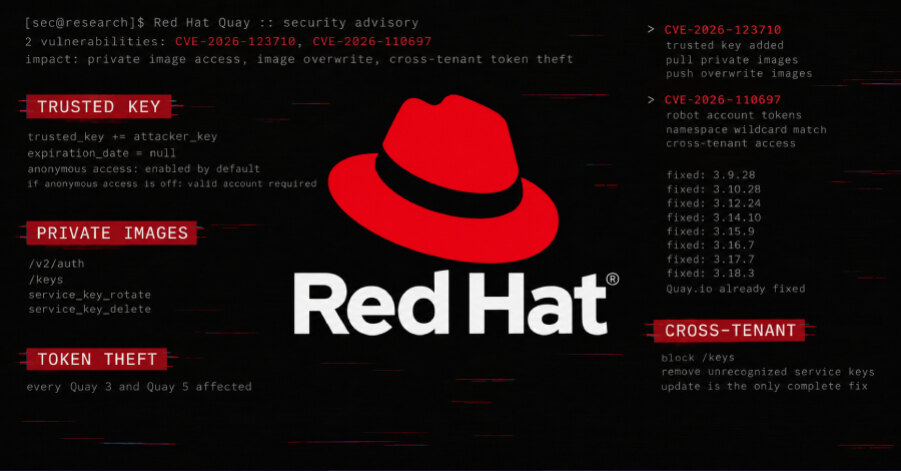
Red Hat has released fixed builds for eight Quay 3 branches after disclosing two critical vulnerabilities that can expose, alter or disrupt private container-image registries. CVE-2026-123710 has a CVSS score of 9.8 and can let an attacker add a signing key trusted by Quay; CVE-2026-110697 is rated 9.9 and can expose other tenants’ robot account tokens.
Red Hat lists every Quay 3 and Quay 5 version as affected by both issues. The company says the exposure includes standalone deployments, Quay installations managed by the Quay Operator on OpenShift, and the mirror registry for Red Hat OpenShift. Any Quay instance reachable by untrusted clients, including an internal registry, is in scope.
Trusted signing keys can be planted
Quay relies on trusted keys to sign access tokens for image pulls and pushes. The first flaw allows an attacker to add their own key to Quay’s trusted-key set without an expiry date. Tokens signed by that key can then be accepted for any repository, allowing private images to be retrieved or images to be pushed and overwritten.
Anonymous access is enabled by default. In that configuration, no account is required to exploit CVE-2026-123710; if anonymous access is disabled, a valid account is still sufficient. The issue lies in the key server’s replacement check: it validates that a token is signed by a trusted key and has the expected audience and issuer, but does not verify that the token was issued for key rotation.
An anonymous token issued through Quay’s /v2/auth endpoint passes those checks because Quay signs it with a trusted key and the caller can select its audience. A planted key survives restarts until removed. It may also be used to delete keys used by running Quay instances, causing ordinary pushes and pulls to fail with authentication errors.
Robot tokens exposed through namespace matching
The second vulnerability affects code used to list robot accounts. Quay builds an SQL LIKE pattern from a namespace name without escaping wildcard characters. Because an underscore matches any single character in SQL LIKE, an attacker able to create a namespace with a suitably placed underscore can match another tenant’s namespace and obtain its robot accounts with decrypted tokens.
No elevated privileges or victim action are required for that attack. The stolen credentials can be used to read, push or overwrite a victim’s images. In OpenShift environments where Quay is the integrated registry, Red Hat warns that those credentials could be used to inject malicious images into CI/CD pipelines. Deleting the attacker’s namespace can also delete the related robot accounts and interrupt systems that depend on them.
Update and investigate exposure
Red Hat says updating is the only complete remediation for CVE-2026-110697, and Quay.io is already fixed. Its upstream changes add the missing rotation check, require keys added through the key server to have expiry dates, prevent callers from selecting a token audience, and address the robot-account search issue.
Before fixed releases are deployed, Red Hat recommends blocking the /keys endpoint at a proxy or load balancer except for trusted internal components. Teams should search audit logs for service_key_rotate and service_key_delete events with a null expiration_date, then remove unrecognised approved service keys. For the robot-token issue, restrict creation of organisations or namespaces containing underscores, rotate tokens for namespaces that can match such names, and investigate unusual robot pulls or pushes.
Removing an unauthorised key alone is not durable while the vulnerable code remains, and disabling anonymous access does not eliminate the first flaw. Organisations operating Quay should prioritise the fixed release, constrain access to sensitive registry endpoints, and treat anomalous key or robot-token activity as a reason to assess the integrity of images used by downstream systems.