


MIT survey identifies sustainability governance gaps in supply chains
MIT’s Sustainable Supply Chain Lab has released its 2026 State of Supply Chain Sustainability report, finding that 83 percent of 1,810 supply chain professionals surveyed across 91 countries consider sustainability important or very important to long-term business success. That is the highest result in the report’s seven-year history, but the research also identifies a substantial divide between public commitments and the structures needed to deliver them.
Fifty-nine percent of respondents said their organizations became more committed to sustainability after recent U.S. policy shifts that deprioritized environmental concerns. At the same time, 68 percent said tariff uncertainty had forced them to delay, reduce, or abandon sustainability strategies. Nearly one-third reported that tariff-related disruption had increased operational emissions.
Commitment is not governance capacity
Among organizations with publicly stated sustainability goals, only 51 percent have a formal cross-functional sustainability team. The report identifies such teams as the governance arrangement most strongly associated with incorporating sustainability into daily business decisions. Only 33 percent of respondents said sustainability oversight sits at board level.
The difference in reported operational integration is pronounced. Companies with formal cross-functional teams said sustainability is built into decisions “frequently or always” 57 percent of the time. Where responsibility is concentrated in a single function, the corresponding figure is 13 percent, a 44-point gap.
Sustainability is most commonly embedded in transportation and logistics, cited by 39 percent of respondents, followed by procurement at 35 percent, warehousing at 34 percent, and product design at 33 percent. It is less present in capital investment, network design, and supply-chain risk planning, where long-term emissions can be determined.
External disruption and AI complicate execution
More than eight in 10 respondents in North America, Europe, and Asia agreed that ongoing geopolitical conflict is reducing the effectiveness of their organizations’ climate action. The report says decarbonization plans had been built on assumptions of stable trade and relative peace, conditions that are no longer holding.
Artificial intelligence is also producing mixed results. Seventy-eight percent of North American organizations reported using AI in sustainability initiatives, and 87 percent of adopters reported a positive effect on sustainability goals. Respondents cited reduced material waste, reduced energy use, and AI-supported estimates for missing supplier emissions data.
However, only 53 percent of mature agentic AI users reported lower total greenhouse-gas emissions, while 29 percent reported an increase. In advanced and fully automated warehouses using AI, 78 percent reported higher energy use and 76 percent higher waste after implementation; only 24 percent used AI-driven real-time monitoring to track environmental consequences.
Collaboration expands while freight transitions remain uneven
Scope 3 collaboration was a notable positive finding. Participation in joint supplier engagement and decarbonization programmes rose from 31 percent to 58 percent in one year, while partnerships addressing shared suppliers’ emissions more than doubled from 23 percent to 55 percent. The share working entirely alone fell from 18 percent to 6 percent.
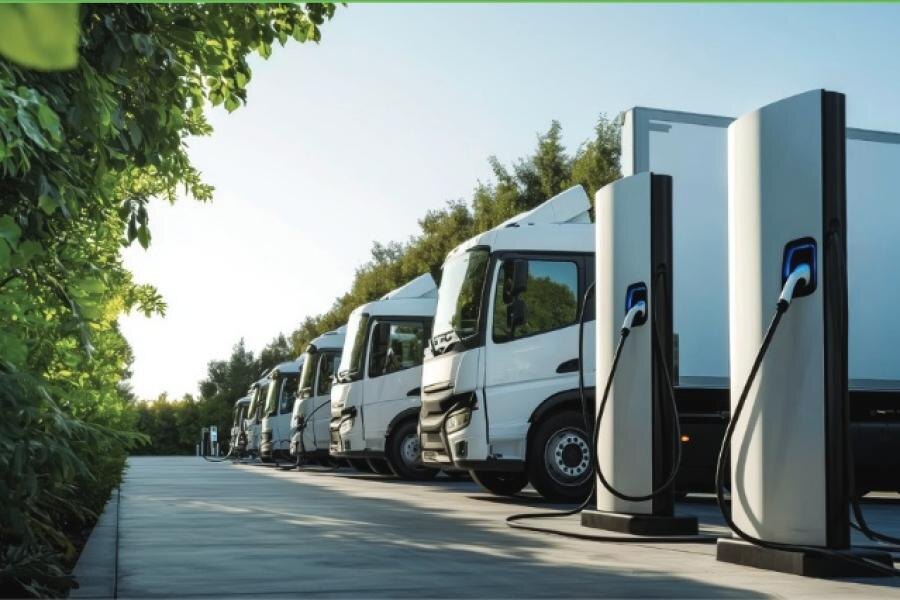
Freight operators are using route optimisation, load consolidation, and driver-behaviour programmes, yet 43 percent of fleets still run mostly or entirely on conventional diesel and only 8 percent have completed a transition to low-emission energy. Battery-electric vehicles are at scale at 60 percent of European companies, compared with 36 percent in North America.
For businesses, the report’s practical implication is to pair sustainability targets with board-level oversight or cross-functional ownership, measurement systems, and resilience planning so that commitments can remain actionable when trade, policy, and technology conditions change.