


Compromised Swarm Releases Delivered Wallet Theft Malware
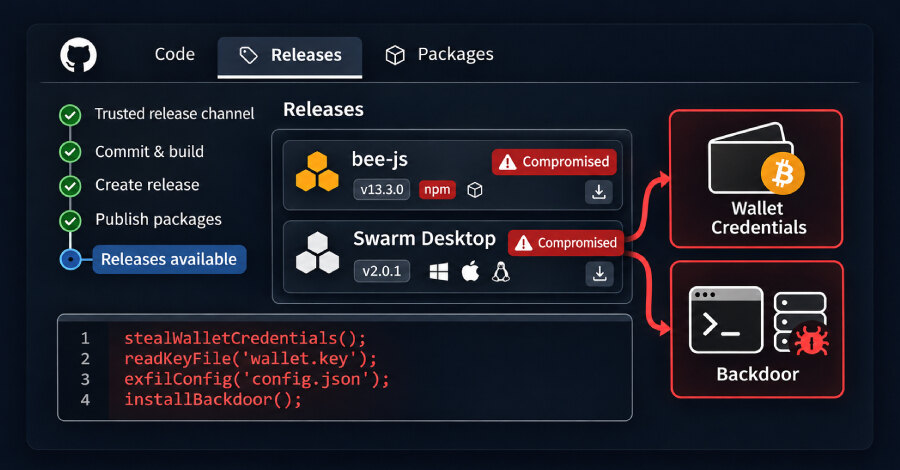
Attackers used Ethersphere’s release automation to publish malicious versions of two tools for the Swarm decentralised storage network: bee-js 13.3.0 and Swarm Desktop 0.56.2. The releases were designed to steal the private-key file and plaintext password used by Swarm Desktop, then install backdoors on Windows, macOS and Linux systems.
The malicious bee-js package was the latest npm version for about 75 minutes, from 00:09 to 01:25 UTC. Swarm Desktop 0.56.2 appeared on GitHub at about 00:36 UTC and was withdrawn roughly 8.5 hours later. Socket estimated that bee-js 13.3.0 was downloaded around 10 times, including by scanners and mirrors, while Swarm Desktop 0.56.2 reached 65 downloads by 08:27 UTC, also including researchers.
Trusted release workflows were abused
bee-js is the JavaScript library used by Swarm Desktop and the swarm-cli command-line tool. Its malicious code ran as an npm postinstall script, meaning installation could execute the payload even where a project never imported the library. Fresh installations of packages whose version ranges accepted 13.3.0 could therefore retrieve the compromised dependency.
For Swarm Desktop, the malicious loader executed each time the app started. It downloaded further code from api.frameworkmetrics[.]xyz with the user’s permissions. That code sought config.yaml and data-dir/keys/swarm.key in the application data folder, then sent both files to the attackers. The key file is an encrypted Ethereum keystore, while the configuration file keeps its password in plain text.
With those files, attackers could access the node wallet’s xDAI and xBZZ tokens, chequebook funds and stake. No theft of funds had been reported at the time of publication, but the GitHub advisory says any computer with bee-js 13.3.0 installed or running should be considered fully compromised.
Backdoors persist after an update
The downloaded payload also installed persistence mechanisms. On Linux and macOS, it placed a Go remote shell called evjawbreaker in a hidden ~/.solidity directory, using a Linux user service or a macOS LaunchAgent. On Windows, it installed a legitimate ConnectWise-signed ScreenConnect client as a system service and connected it to an attacker-controlled relay.
Ethersphere withdrew the affected desktop release and issued Swarm Desktop 0.56.3, described by a maintainer as the same code as 0.56.1 with a newly issued Developer ID certificate. The maintainers said 0.56.2 had been published by an attacker using stolen CI credentials. The compromised releases were produced through the project’s own workflows, so bee-js also carried valid npm provenance; that record identifies the repository and build workflow, not whether code received review.
Actions for development and security teams
Teams using bee-js should search lockfiles, caches, internal registries and CI logs for @ethersphere/bee-js@13.3.0, pin version 13.2.0 and remove cached malicious copies. If installation scripts were enabled, credentials, tokens and keys accessible to the installing user or runner should be rotated from a clean computer.
Swarm Desktop users should check bee-desktop.log for version 0.56.2, install 0.56.3 and manually replace Linux packages. If 0.56.2 ever ran, the node key and password must be treated as stolen; moving funds, chequebook and stake to a new key and rebuilding affected machines from trusted images is the practical business response.