


TPM rollback flaws weaken Windows Hello and BitLocker PIN protection
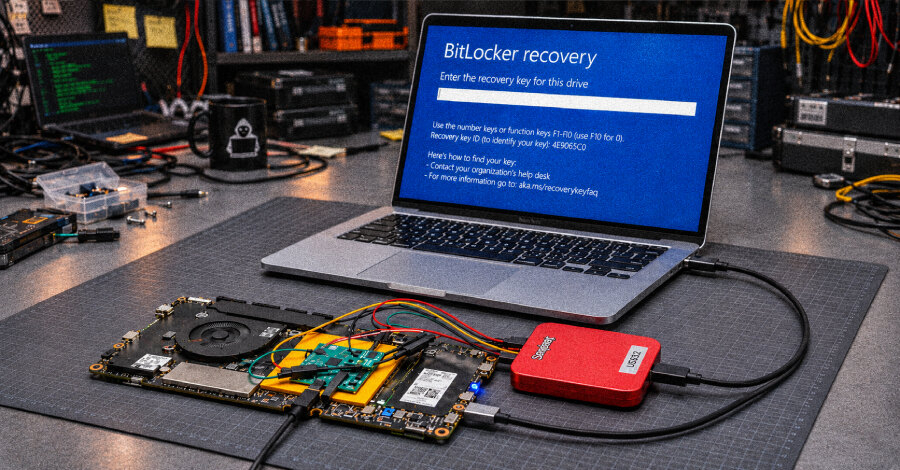
Researchers at Technische Universität Berlin have demonstrated physical attacks that can reset TPM lockout counters on some AMD- and Intel-based PCs, substantially reducing the time needed to guess Windows Hello and BitLocker PINs. In laboratory tests, the team recovered a four-digit Windows Hello PIN on an AMD HP OmniBook 3 and a six-digit BitLocker startup PIN on an Intel-based Framework Laptop 13, each after 236 attempts.
Based on the measured attack speeds, the researchers calculate that a four-digit Hello PIN could take at most 40 hours to exhaust rather than 69 days with the documented TPM lockout behaviour. For a default six-digit BitLocker PIN, the estimated worst case falls from 19 years to 20 days. The experiments required opening the devices, removing the motherboard flash chip and inserting a custom board.
How TPM lockout counters can be rolled back
The affected systems use a firmware TPM integrated into the processor rather than a separate TPM chip with its own secure storage. Its persistent state, including the count of failed PIN attempts, is stored in encrypted form on the motherboard flash. Restoring an earlier copy of that state can reset the failed-attempt count unless the system detects the rollback.
Newer systems use replay-protected monotonic counters, or RPMC, in the flash device to identify such rollbacks. On AMD systems using RPMC, the researchers found that firmware does not verify whether a counter increment actually occurred. An interposer board can block the update while reporting success, enabling the older TPM state to be accepted. AMD confirmed the processor firmware issue as CVE-2026-43613, with a CVSS score of 5.1.
The team also found that a brief voltage glitch against Winbond RPMC flash can expose the secret key used to sign counter values. With that key, an attacker can forge counter values. On the tested Intel laptop, firmware supplied the same value to the flash device at every boot, allowing the extracted key to continue working after restarts. Intel said the research did not demonstrate a vulnerability in an Intel component.
Vendor response and affected hardware
AMD plans firmware fixes for most affected Ryzen, Ryzen AI, Ryzen Threadripper, Athlon and EPYC processors between November 2026 and February 2027. These are dates for AMD firmware availability, not necessarily for PC-maker updates. AMD says attacks needing physical access fall outside its product security threat model, while noting that RPMC is intended to stop this kind of interposer attack.
Systems without RPMC may also be exposed differently. In tests on two AMD desktops without RPMC flash, an ordinary flash programmer was sufficient to restore a prior state. The researchers caution that those two systems may not represent every AMD configuration. They also say PCs relying on vulnerable Winbond RPMC flash may be susceptible irrespective of processor, while a new chip design may be necessary to address the voltage-glitch issue.
Actions for administrators and device owners
Microsoft has reportedly committed to increasing its recommended minimum Windows Hello PIN length to six digits. A Windows 11 test build has also set six digits as the minimum for personal-account Hello PINs, while retaining an option to use four. Administrators can raise the Windows Hello for Business Minimum PIN length policy and the BitLocker startup minimum PIN length policy; BitLocker supports four to 20 digits and can permit enhanced PINs with letters and symbols.
Two extra digits materially increase the researchers' calculated brute-force times. Organisations should install relevant AMD firmware updates when their PC manufacturer provides them, increase Hello and BitLocker PIN requirements, and maintain physical control and tamper awareness for endpoints until applicable fixes are deployed.