


Microsoft fixes SmartScreen VBS enclave code execution flaw
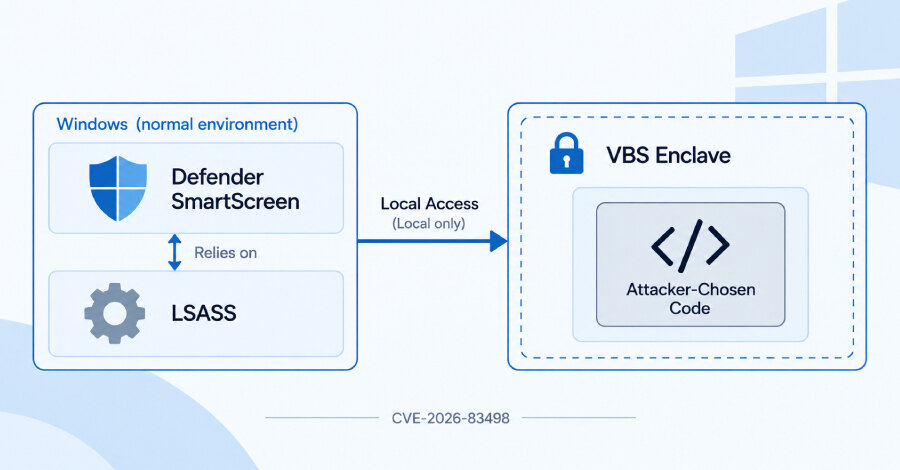
Microsoft has fixed CVE-2026-83498, a Critical elevation-of-privilege vulnerability that researchers at Doyensec used to run attacker-chosen code inside the Windows SmartScreen VBS enclave. Microsoft assigned the issue a CVSS score of 7.8 and addressed it in the September 8, 2026 cumulative update, KB5124008, for Windows 11 versions 24H2 and 25H2.
The flaw affects SFAPE.dll, the enclave used by Microsoft Defender SmartScreen's Enhanced Phishing Protection. Doyensec published its proof of concept on October 13, after the update was released. Microsoft said the vulnerability was not publicly known before the fix, had not been exploited, and had also been identified internally.
Why the enclave boundary matters
Virtualization-based Security enclaves are signed libraries loaded by ordinary Windows processes but protected after execution begins. Their memory runs in Virtual Trust Level 1, also called Isolated User Mode, while normal host code operates in VTL0. Windows is designed to preserve that boundary even if an attacker compromises the normal kernel or obtains SYSTEM-level execution.
In this case, lsass.exe loads the SmartScreen enclave. The component helps Enhanced Phishing Protection detect when a user types or pastes a Windows sign-in password into an unsafe destination, such as a phishing page or Notepad. Windows stores a hashed form of the password inside the enclave so later input can be compared without exposing the credential outside that protected area.
The attack is local rather than remote. It requires code already running on the machine and a process that can load and call the enclave; for SFAPE.dll, that process is LSASS. The research therefore does not provide an initial-access technique, but shows how an existing foothold could be extended into a more trusted Windows execution environment.
How Doyensec built the chain
Doyensec found that invoking the enclave's Initialize function a second time causes a fixed four-byte error value to be written to an address controlled by the caller. The first invocation performs an address check, but the second path does not. The researchers stressed that the primitive alone is limited rather than a general arbitrary write.
Placed at a suitable location, however, the write can corrupt the value the enclave uses to distinguish its own memory from host memory. That disables a safety check. A timing weakness in a separate function can then trigger a controlled wipe, changing the way the enclave resolves a stored object. The resulting read and write operations allowed the researchers to replace the table that determines which code the enclave can execute.
The proof of concept broke enclave isolation but did not demonstrate reading or stealing a user's password. Microsoft's advisory describes the potential impact as data leakage from, or code execution within, the enclave.
Patch deployment is the available response
KB5124008 adds an address check before the initial write and tightens the function implicated in the timing issue. Doyensec's comparison of the old and new files also found a new policy that prevents the vulnerable SFAPE enclave from loading, meaning patched systems cannot load the old file. Microsoft provides no separate workaround.
Doyensec noted that Windows lacks a broad blocklist for vulnerable enclaves comparable to its vulnerable-driver blocklist. The new policy blocks the old SFAPE file specifically, while an older Microsoft Edge enclave affected by CVE-2023-36880 remains loadable. Organizations should therefore treat deployment of KB5124008 as the practical immediate action and verify that Windows 11 24H2 and 25H2 devices receive the update.