


Actively Exploited Xen Orchestra Bug Can Give Attackers Admin Access
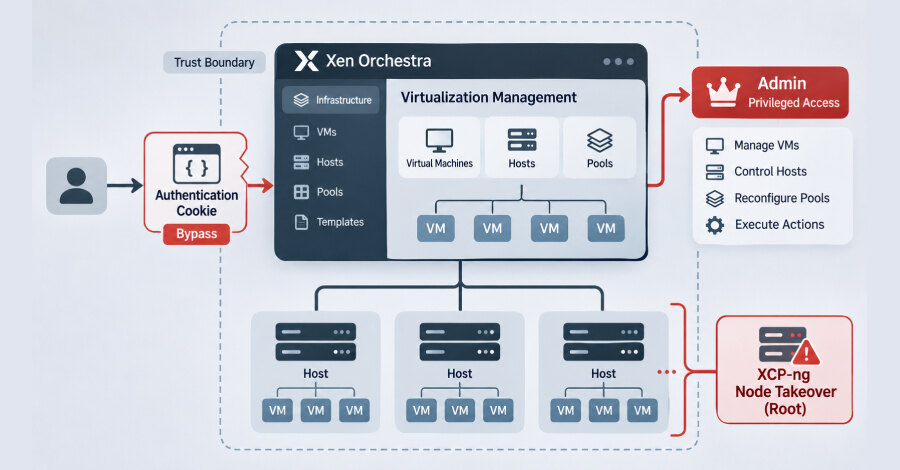
Vates VMS has warned that attackers are actively exploiting VSA-2026-062, a critical authentication-bypass vulnerability in Xen Orchestra. The flaw has no CVE identifier and can let a remote attacker obtain Admin-level access, perform arbitrary actions, execute code on managed pools and ultimately take over an XCP-ng node as root.
The issue is fixed in Xen Orchestra 6.9.1 for the stable channel and 6.10.0 for the latest channel. Vates VMS also released fixes in xo-server 5.211.2 and 5.213.1. Organizations running affected management infrastructure should identify their deployed version and move to the relevant patched release.
How the authentication bypass works
Vates VMS said REST cookie parsing turns authenticationToken=j:%7B%7D into an empty object. REST authentication then passes that object to the Xen Orchestra token provider without requiring the token to be a string.
The token collection interprets the empty object as an unfiltered lookup and returns its first token. If that token is still valid, the provider authenticates the request as the token owner. An authenticated request to the /rest/v0/users/me/authentication_tokens route can then return reusable login token IDs.
That chain gives the issue an unusually serious operational impact: an attacker can bypass normal authentication controls and act with Admin privileges. Vates VMS said this can lead to arbitrary code execution on managed pools and full root-level takeover of an XCP-ng node.
Active exploitation and indicators
Vates VMS reported observing exploitation from 91.211.251[.]112:8001 and the Tor address ustar3rqxgnskzgnwkgpofgtvxevm6cx3lxdbwt4mndtveqyaohid[.]onion:3333. The IP address has been flagged on VirusTotal as a RedLine Stealer command-and-control server. The company did not say when the activity began or whether the vulnerability was used as a zero-day.
Defenders should investigate HTTP requests containing authenticationToken=j:%7B%7D or authenticationToken=j:{}. Other listed indicators include a running virtual machine named pivot2, virtual machines configured with the hvm_serial: file parameter, and suspicious files including /etc/cron.d/zz-ustar2, /etc/cron.d/zz-ustar, /.ustar5 and /.ustar6.
Immediate defensive steps
Where an immediate update cannot be applied, Vates VMS recommends avoiding internet exposure for Xen Orchestra, blocking the reported IP address and Tor domain, and filtering the empty token at a web application firewall or reverse proxy. Filip Magic and Christoffer Olsen of TDC NET Security were credited with reporting the flaw.
For businesses operating Xen Orchestra and XCP-ng, the practical priority is to patch the management plane, review the specified indicators and rotate all passwords and secrets if evidence of compromise is found.