


Ramp sees August slowdown in business AI spending
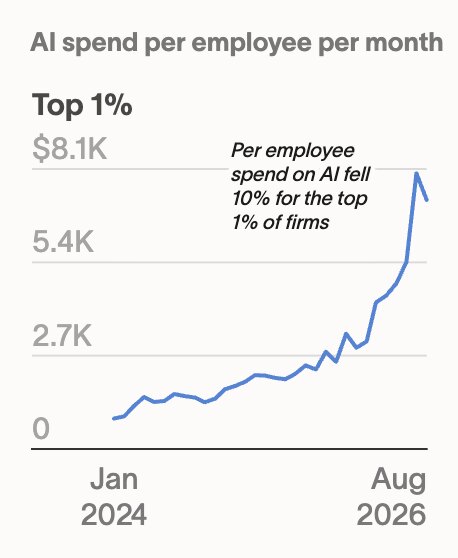
AI purchasing growth slowed in Ramp’s August data
Business adoption of AI tools slowed in August in spending data collected by payments company Ramp across 70,000 companies. Ramp said 56% of its customers paid for AI products during the month, an increase of only 0.4 percentage points from July.
The more notable change was among the largest AI spenders in Ramp’s sample. AI expenditure per employee at the top 1% of firms declined by nearly 10% to $7,205. The figures raise questions about whether demand is merely following a seasonal summer pattern or beginning to respond to falling model prices and changing customer behaviour.
Ramp has recorded a similar late-summer slowdown before. Its AI index showed little or no adoption growth between August and October last year, before growth accelerated again towards the end of the year. That history means the August movement alone cannot establish a sustained reversal.
Lower token prices reshape the spending signal
Ramp economist Ara Kharazian said vacation periods may have contributed to lower token consumption, but pricing is also relevant. Average token costs fell to $0.68 per million tokens, compared with a March 2026 peak of $1.15 per million tokens, after price reductions by OpenAI and Anthropic.
Ramp’s data suggests that increased usage has not yet offset those price reductions. Customers also have an incentive to select older and less expensive models, including OpenAI’s ChatGPT 5.6-Terra and Anthropic’s Sonnet, rather than the newest frontier releases. This affects businesses whose economics depend on token expenditure rising as AI usage expands.
The payment data is not a complete measure of the US market. Ramp’s customer base is technology-oriented, which may make its adoption rate higher than the broader economy. A US Census Bureau survey updated on August 23 found that 22% of businesses reported using AI. Even so, direct corporate-spending data can provide a useful view of purchasing behaviour.
Infrastructure demand depends on sustained usage growth
The distinction matters for frontier model developers and hyperscalers investing heavily in AI infrastructure. Their expected returns depend on revenue growing alongside use of AI services. Software engineers’ adoption of agentic coding tools has contributed to steep usage growth, but a slowdown in adoption could also slow revenue growth.
Open-weight competition has not yet become a large driver in Ramp’s figures. Only 6.4% of AI-spending businesses used model-serving or inference platforms in August, although that share is increasing steadily. Kharazian said competition between OpenAI and Anthropic is making AI more accessible while reducing spending at the largest customers that had been expected to generate much of the market’s growth.
For businesses using AI, lower prices can improve access and reduce operating costs. The practical implication is to monitor adoption, workload volume, model selection and spend per employee together, since a falling AI bill may reflect price competition and a shift to cheaper models rather than weaker operational use.